
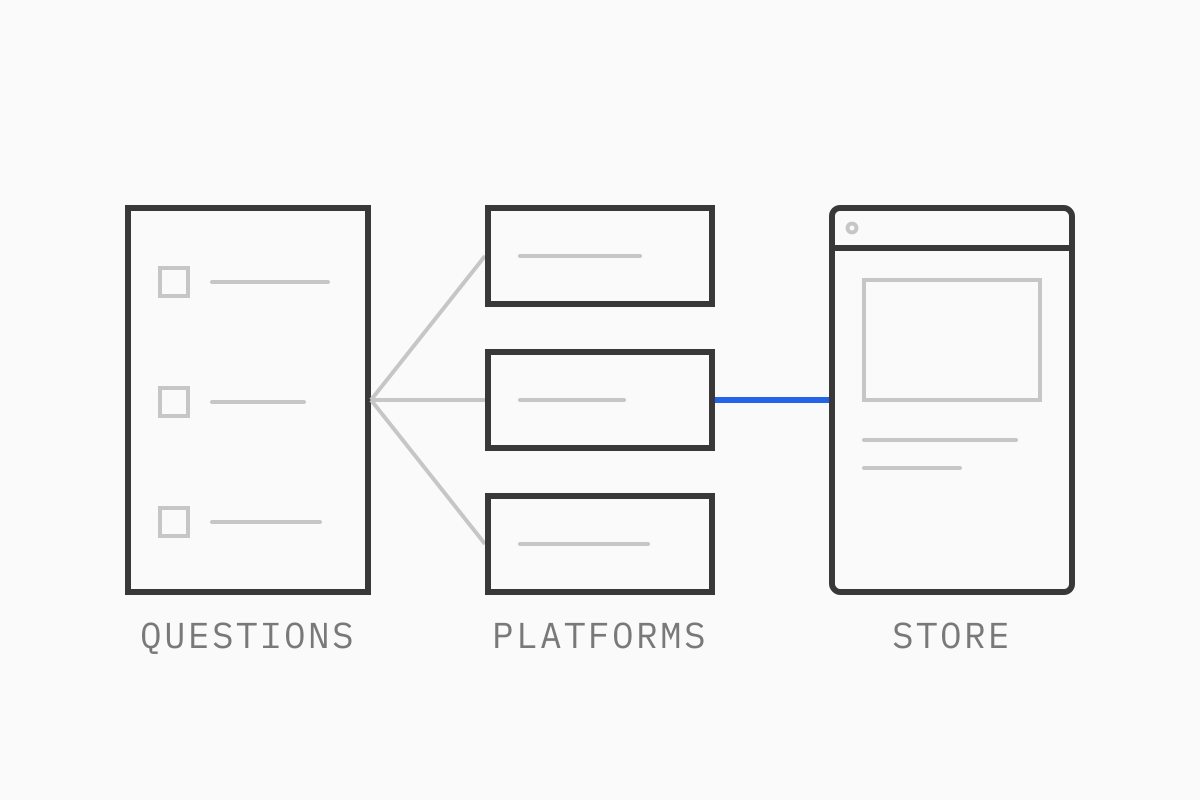
The six questions: who runs the site, how complex the catalog is, which markets you sell in, what your B2B rules are, which systems it must talk to, and what it will cost over three years. For B2B, Shopify Plus, Adobe Commerce (Magento), Salesforce Commerce Cloud, BigCommerce and a custom build can each be the right answer, depending on how you price, quote and invoice.
This guide is for founders, heads of eCommerce and CTOs at brands doing roughly $5M to $100M a year, and at larger B2B businesses, who are replatforming or outgrowing what they have. For context: YYT has been a Shopify Select Partner since 2019 and most of our commerce builds today are on Shopify. We built Magento sites for years before that, and we build custom software when a business needs it.
01Six questions to answer before you compare platforms
Write down answers to these before you take a single sales demo.
1. Who will run the site day to day?
If your eCommerce team is three marketers and an agency, you want a hosted platform where security, uptime and checkout are someone else’s problem. With an in-house development team of five or more, a more open platform or a custom build becomes realistic because someone can own it. A platform that needs a permanent development team you never hired is the most expensive mistake on this list.
2. How complex is your catalog?
Count SKUs, variants and the relationships between them. Shopify raised its limit from 100 to 2,048 variants per product in October 2025. Configurable products (a ring with a chosen stone, metal and engraving), bundles and kits still need checking against each platform’s data model. Above tens of thousands of products, test performance before you commit, particularly on self-hosted platforms.
3. Which markets do you sell in?
List countries, currencies, languages and tax regimes, now and in three years, and whether each market needs its own store, catalog or inventory.
4. What are your B2B rules?
Document how you sell to businesses today: who sees which prices, how quotes are agreed, who can order on behalf of a company, what payment terms you offer and how invoices are settled. This question has its own section below.
5. What does it need to integrate with?
ERP, PIM, OMS, CRM, 3PL, tax, search, email. For each, note whether there’s a maintained connector, an integration platform (iPaaS) route, or custom work. The ERP sync is usually the largest and riskiest piece of a B2B build.
6. What will it cost over three years?
License fees are the visible part. Add implementation, apps, hosting where it isn’t included, payment processing and transaction fees, ongoing development and the internal headcount the platform needs. Then ask every vendor how its fee changes as your revenue grows.
02The platforms compared
At the time of writing, the five options compare like this.
Shopify Plus | Adobe Commerce | Salesforce | BigCommerce | Custom | |
|---|---|---|---|---|---|
Hosting | SaaS | SaaS, PaaS or self-hosted | SaaS | SaaS | Your cloud account |
Published pricing | From $2,300/month | Quote only | Quote only | Performance plan from $1,499/month | Build and run costs |
Native B2B | Yes, all plans | Yes, B2B module | Separate B2B Commerce product | B2B Edition | Yes, built to spec |
Typical team | Small in-house team plus a partner | Dedicated developers | Salesforce-skilled partner | Small team plus a partner | In-house or embedded developers |
Best fit | DTC and standard B2B | Complex catalogs and quote-heavy B2B | Enterprises already on Salesforce | Mid-market B2B and multi-storefront | Unusual pricing or order rules |
Shopify Plus
Shopify Plus is the enterprise tier of Shopify. At the time of writing it starts at $2,300 a month on a three-year term or $2,500 on a one-year term, plus a variable platform fee for some higher-volume or more complex businesses, so ask for your actual number. One contract covers one brand, with nine expansion stores included.
Checkout, hosting, security and uptime are Shopify’s job, the app ecosystem is the largest here, and a marketing team can run a Shopify theme without a developer on every change.
The limit: you can’t change how the core platform works, only extend it through apps, Shopify Functions and checkout extensibility. If your pricing logic, order flow or product data model is unusual, you’ll be working around Shopify rather than with it. Costs also creep through apps, each with its own monthly fee.
The move to Plus is often a cost decision rather than a feature one. Kimai, a fine jewelry brand, started on a standard Shopify plan and moved to Plus once the transaction fees on its sales grew too high to justify. At the time of writing, Shopify charges 0.6% on orders through a third-party payment provider on Advanced and 0.2% on Plus, and card rates with Shopify Payments also fall on Plus. Past a certain revenue, the gap outweighs the higher subscription, so run that calculation on your own numbers first. We now run Kimai’s headless Shopify Plus storefront, with a React front end and Contentful, across four international sites (US, UK, Europe and a French translation).
Most brands don’t need headless to get value from Plus; our guide to headless Shopify vs a Shopify theme covers where that line sits.
Adobe Commerce (Magento)
Adobe Commerce is the licensed version of Magento; Magento Open Source remains free and self-hosted. Adobe sells it as SaaS (Adobe Commerce as a Cloud Service), as single-tenant PaaS (Adobe Commerce on Cloud), and as Adobe Commerce Optimizer, a storefront and merchandising layer for another commerce engine. Pricing is by quote.
Its strength is depth. The B2B module covers company accounts with hierarchies and roles, shared catalogs with company-specific pricing, negotiable quotes, requisition lists, purchase order approval rules and payment on account. If your sales process involves back-and-forth on price before an order exists, Adobe Commerce models that natively.
The trade-off is the team it needs. Our Magento 2 work included catalog and checkout work for Graze on one of the first UK Magento 2 Enterprise releases, and a headless storefront with a React front end on Magento 2 and Contentful for Dundas London. Those builds needed developers on hand for upgrades, extension conflicts and performance tuning. The SaaS edition, with automatic updates, is designed to reduce that load; we haven’t built on it, so we can’t say how far it does.
Salesforce Commerce Cloud
Salesforce Commerce Cloud comes as B2C Commerce and B2B Commerce, sold in editions priced by quote at the time of writing. The Premier success plan is listed at 30% of net license fees.
It makes most sense when the business already runs on Salesforce. B2B Commerce shares data with Sales Cloud and Service Cloud, so negotiated pricing, entitlements and a rep’s view of the customer come from the same records. That integration is the reason to buy it; without it, you’re paying enterprise license fees and hiring a Salesforce-specialist partner for a storefront other platforms deliver for less. Ask early how the fee scales with your sales volume. Our own work on the platform was for a client in Dubai, mostly data attribution, with front-end changes, back-end logic and webhooks.
BigCommerce
BigCommerce is a SaaS platform with published plans up to Performance, which starts at $1,499 a month billed annually, and an Enterprise tier priced by quote. Lower plans move up automatically as trailing 12-month sales pass set thresholds.
B2B Edition adds company accounts with roles and hierarchies, sales-rep quoting, shared shopping lists, an invoice portal where buyers can pay, per-buyer payment methods and an open-source buyer portal. Multi-storefront from one back end helps if you run several brands or regional sites.
On BigCommerce Enterprise vs Shopify Plus: BigCommerce gives you more native B2B tooling; Shopify Plus has the larger app and partner ecosystem and the stronger DTC checkout. If B2B is most of your revenue and your process includes quoting and invoice payment, put BigCommerce on the shortlist. Our BigCommerce experience is limited to minor changes on an existing site, so weigh our view accordingly.
Custom or composable builds
A composable build combines separate services (a commerce engine, a CMS such as Contentful, search) behind a front end you own; a fully custom build writes the business logic too.
It makes sense when your business model doesn’t map onto a cart and checkout: configured-to-order products, quote-only sales, complex dealer networks, or a process the business competes on.
The cost: you own security, uptime and every feature a platform would give you for free, so budget for a team to maintain it.
Some B2B businesses don’t need online checkout at all. CORE Transformers, a US manufacturer of electrical distribution transformers, needed a modern site to replace WordPress quickly, with quote, repair and rental requests going to their sales team. We built it in Next.js and TypeScript with Contentful, Node.js and AWS. If your buyers order through reps and your ERP, start there before shortlisting any of the platforms here.
03How to choose a B2B eCommerce platform
Check each platform against these five requirements.
Customer-specific pricing. Can you assign a catalog or price list to one company, or only to a group or market? Can prices vary by quantity?
Quotes. Can a buyer request a quote, a rep adjust it and the buyer accept it as an order, all in the platform, or does negotiation happen by email?
Company accounts. Can one company have several locations, buyers and roles, with approval rules on who can spend what?
Payment terms. Net 30 or net 60, deposits, purchase order numbers, paying by invoice, ACH, and partial payments against fulfillments.
ERP sync. Your ERP is usually the source of truth for customers, prices, inventory and credit limits. Ask which connectors are maintained, which data flows in each direction, and how often.
What Shopify B2B covers natively
At the time of writing, Shopify B2B is available on every Shopify plan, not only Plus. Natively it includes:
Companies with multiple locations and location-level permissions for buyers
B2B catalogs with quantity rules and quantity price breaks
Net payment terms of 7 to 90 days, payment due on fulfillment, payment reminders, vaulted cards, ACH in the US and PO numbers
Draft orders sent as invoices, and the option for a buyer’s checkout to become a draft order you review before approving
Quick order lists, easy reordering and a trade theme
Direct ERP connectors listed by Shopify for Acumatica, Microsoft Dynamics 365 Business Central, NetSuite and QuickBooks Online, plus iPaaS options and B2B APIs for everything else
On Plus only: unlimited catalogs (other plans can assign three), catalogs assigned directly to a single company, deposits, partial payments and payment per fulfillment. So if every trade customer has their own negotiated price list, you need Plus.
Where Shopify is lighter: quoting runs through draft orders rather than a dedicated negotiation workflow like Adobe Commerce’s negotiable quotes, and complex buyer-side approval chains usually need an app or custom work. For a wholesaler with standard tiers, that rarely matters; for a distributor that negotiates every large order, it might decide the platform.
Best eCommerce platform for B2B, by situation
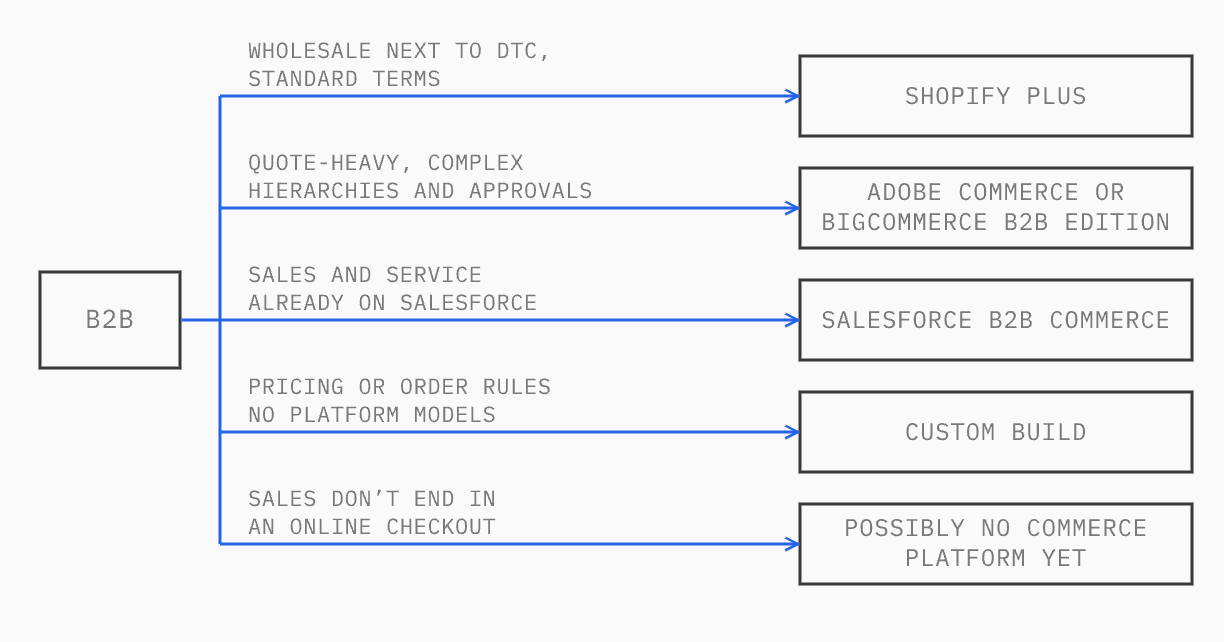
Wholesale alongside an existing DTC brand, standard terms: Shopify Plus.
Quote-heavy B2B with complex company hierarchies and approvals: Adobe Commerce or BigCommerce B2B Edition.
Enterprise already running sales and service on Salesforce: Salesforce B2B Commerce.
Pricing or order rules no platform models: custom.
Sales that don’t end in an online checkout: possibly no commerce platform yet.
04Running the decision
Turn the six answers into a weighted requirements list. Take it to two or three platforms and ask each to demo your hardest scenario, not their standard one. Model three-year cost, talk to a merchant of your size on each, and budget the migration: redirects, data mapping and a performance baseline (our site speed guide covers measuring that).
05Getting a second opinion
You’ll live with a platform for five years or more, and every vendor has a reason to tell you theirs fits. Our developers have 15 years in eCommerce across Shopify Plus, Magento and custom builds. Shopify work is covered under Shopify development; custom platforms and integrations under software development.
Book a call with a technical lead to talk through your shortlist.
06FAQ
Shopify Plus vs Magento: which is better for a growing brand?
For most DTC brands, Shopify Plus: hosting, security and checkout are managed for you and a small team can run it. Adobe Commerce (Magento) suits businesses with complex catalogs or quote-heavy B2B and a development team to maintain it.
How do you choose a B2B eCommerce platform?
Document how you price, quote, invoice and sync with your ERP today, then test each shortlisted platform against those rules, especially customer-specific pricing, payment terms and the ERP connector.
BigCommerce Enterprise vs Shopify Plus: what’s the difference?
Both are SaaS. BigCommerce offers more native B2B tooling through B2B Edition (quoting, invoice portal) and multi-storefront; Shopify Plus has the larger app and partner ecosystem and a stronger DTC checkout. Shopify Plus publishes a starting price; BigCommerce prices Enterprise by quote.