
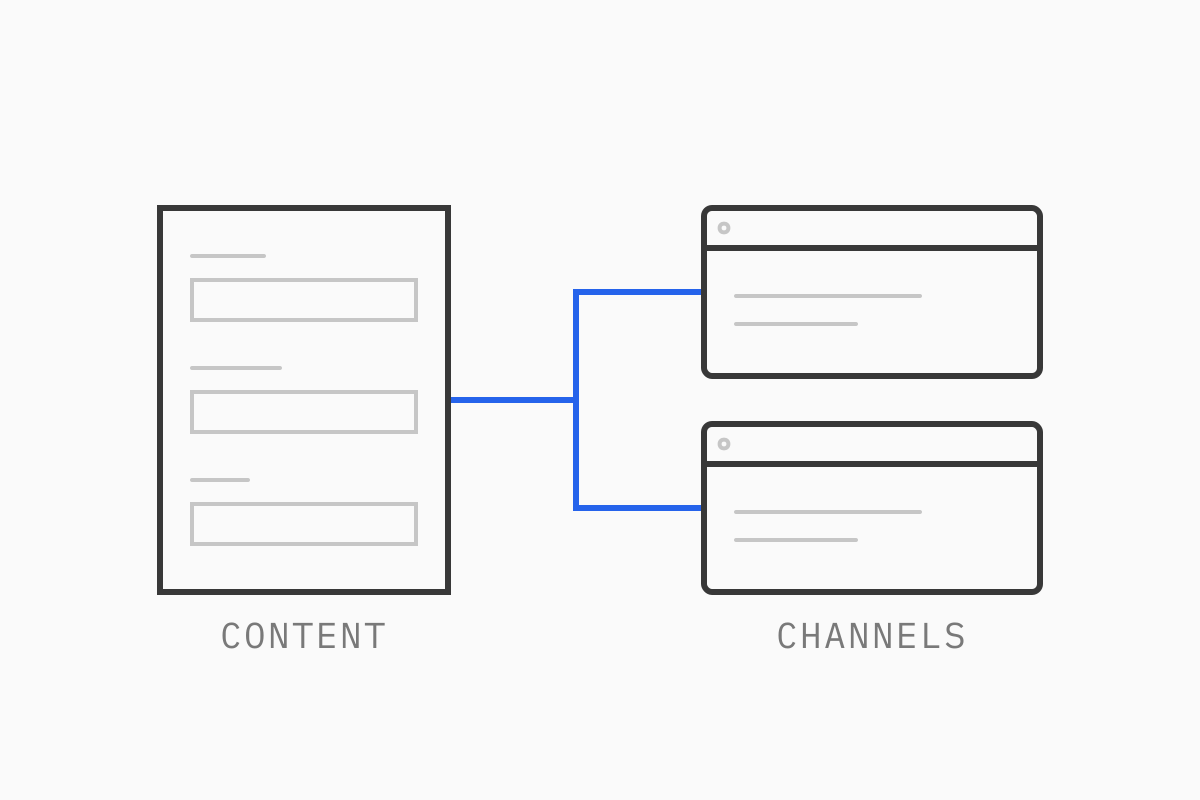
It stores content as structured data rather than as finished pages, which is what makes it good at multi-site, multi-language and multi-channel work, and what makes it more expensive to set up than WordPress.
As a Contentful partner, we’ve launched more than 20 sites on Contentful, for brands in fintech, food, beauty, B2B manufacturing and commerce. This guide covers what we tell marketing and technical leads deciding whether it fits.
01How a headless CMS differs from WordPress
A traditional CMS like WordPress couples content to a single website: you write a page, pick a template, and the CMS renders the HTML. Your content is shaped like the pages it sits on.
Contentful removes the front end entirely. It only stores and delivers content, and developers build the website separately, usually in React or Next.js. Because content is stored as structured data (a product has a name, an image, a list of ingredients, a link to three recipes), the same entry can feed a website, a mobile app, a retailer feed or a campaign microsite without being copied.
That separation is still the core argument:
Content outlives the website. When you redesign, the content model stays. You rebuild the front end and point it at the same API.
Developers and editors work independently. Developers ship code on their own release cycle; editors publish without waiting for a deployment.
No lock-in on the front end. Contentful doesn’t care whether your site is Next.js, Gatsby, a native app or something that doesn’t exist yet.
Delivery runs through a CDN. Published content is served from Contentful’s content delivery network, so the CMS isn’t a server you have to keep fast.
The cost is that nothing works until a developer builds it. There are no themes; every page type your marketing team uses is designed and coded.
02How Contentful works
Spaces and environments
A space is the container for one project: its content, media, content model and languages. A common setup is one space per brand or per website.
Inside a space, environments are copies of the content model and content. The live site reads from master; developers test model changes in another environment before promoting them, so a live site doesn’t break.
Content types, entries and assets
A content type is a template for a kind of content: “Blog post”, “Product”, “Recipe”, “Landing page”, “Hero banner”. Each one has fields (short text, rich text, numbers, dates, media, references, JSON), up to 50 per content type. An entry is one filled-in instance of a content type. An asset is a file: an image, video or PDF.
References
Reference fields link one entry to another. A recipe references the products it uses; a landing page references an ordered list of sections; each section references a call-to-action. Most of the modeling work happens here.
The web app and the marketplace
Editors work in the Contentful web app, a browser-based interface with entry editors, a media library, roles and permissions, and publishing workflows. Developers can extend it with apps: small interfaces that run inside the web app, as a custom field editor, a sidebar panel or a full page. Ready-made apps for Shopify, translation, image tools and analytics are available in the Contentful Marketplace, and you can build private apps for your own team.
We built one of these for the fintech company Yapily: an auto-translation app that sends content to the Google Translate API, writes translations back into the right locale fields, and updates them when the source text changes. Editors working in other languages start from a translation and refine it, rather than writing each page from scratch.
The APIs
Contentful exposes several APIs. The ones that matter for a marketing site:
Content Delivery API: read-only, serves published content to your live site.
Content Preview API: the same shape, but includes drafts, so editors can see unpublished changes on a preview build of the site.
GraphQL Content API: lets the front end ask for exactly the fields it needs in one query.
Images API: resizes, crops and converts images on request, so editors upload one large image and the site gets the right size for each device.
Content Management API: read-write, used for migrations, imports and apps.
03Content modeling: the decisions that matter on day one
Content modeling means deciding which content types exist, which fields they have and how they reference each other. It’s the part of a project that most affects how your marketing team feels a year later, and the part most often rushed.
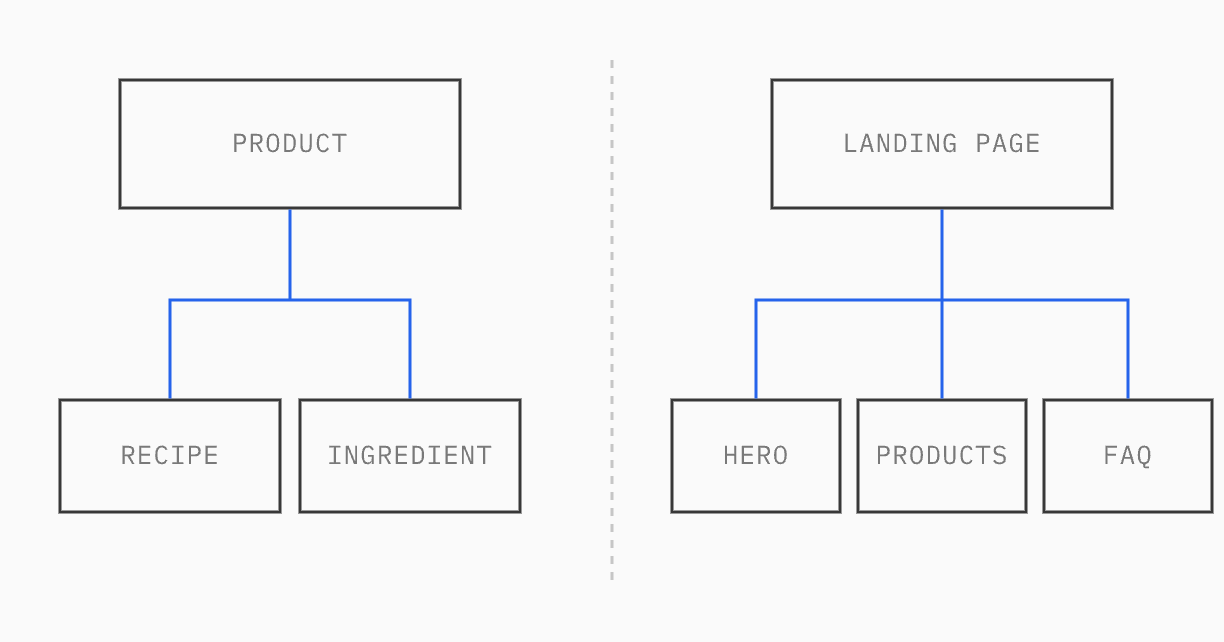
Model the content, not the page. If you create a content type called “Homepage” with 40 fields, editors can change the homepage and nothing else. If you model “Product”, “Recipe” and “Testimonial” as their own types, they can appear on the homepage, product pages and campaign pages from one source. On Deli Kitchen, products and recipes are separate models with dedicated fields for ingredients, method and imagery, and each product links to the recipes that use it. Write a recipe once and it appears everywhere it should.
Give marketers sections, not blank canvases. For landing pages we build a library of section content types (hero, feature grid, recipe carousel, quote, form) that editors stack in any order. Each section has a small, fixed set of fields and a designed look. Marketers get freedom of composition; the brand stays consistent. Deli Kitchen’s team uses the same system for campaign pages, like the Curious Kids Club landing page that combines editorial, recipes and downloadable resources.
Decide what is localized before you have content. Changing which fields are translatable after launch is possible, but it means a migration. See the localization section below.
Name things for editors. Field names and help text are your marketing team’s interface: “Hero image (1600×900, no text)” saves a lot of messages.
Add validation. Required fields, character limits and allowed reference types stop a page going live with a missing image or a 300-character headline.
The model also shapes results. For Ever/Body, we restructured how treatments and packages were modeled in Contentful, gave each its own template, and added filters by category, concern and package type. After the rebuild, homepage click-through rose 2.6x and package conversion tripled.
04What editing feels like for a marketing team
Contentful’s editing experience is a set of structured forms, not a WYSIWYG page. An editor filling in a “Recipe” entry sees fields, not the recipe page. Teams coming from WordPress need some time to adjust.
Two things close the gap:
Live preview. Contentful’s Live Preview shows your actual site next to the entry editor and updates as you type. Inspector mode lets an editor click on something in the preview and jump to the field that controls it.
Releases and scheduling. Editors can group entries and assets into a release, validate them together, and schedule them to publish at a set time.
05Contentful localization
Contentful handles languages with locales (en-US, fr-FR, de-DE and so on). Each space has a default locale, and you choose field by field whether a field is localized. A product’s name and description might be translated while its SKU and price are not.
Locales can have fallbacks: if a Swiss German field is empty, show German; if that’s empty, show English. That lets a regional team override only what differs.
For sites where each market needs different page structures, not just translated text, we sometimes localize at the entry level instead, with separate entries per market. The trade-off is more entries to maintain against more freedom per market.
Multi-market sites are where this planning pays off. On Kimai, one codebase powers four international sites (US, UK, Europe and a French translation), with content for each market managed in Contentful.
06Contentful pricing
Contentful prices by plan, with limits on users, locales, records, environments and API calls. At the time of writing, its pricing page lists:
Plan | Price | Key limits |
|---|---|---|
Free | $0 | 10 users, two locales, one starter space, 10,000 records, 100,000 API calls a month |
Lite | $300 a month | 20 users, three locales, one million API calls a month; an additional Lite space with 50,000 records and four environments costs $850 a month |
Enterprise | Custom | Unlimited spaces and API calls, custom roles and locales, SLA up to 99.99% |
Studio and Personalization are priced separately through sales; AI Actions comes with Enterprise.
A single-language site with a small team can run on the lower tiers. Multiple markets, several brands, custom roles or an uptime SLA usually point to Enterprise. Locale count is a pricing lever too. The license is rarely the biggest cost, though: designing the content model and building the site usually are.
07Should your team use Contentful?
Contentful is a good fit when at least one of these is true:
You publish to more than one site, market or channel and want one source of content.
You have a marketing team that publishes often and should not need a developer to launch a landing page.
Your site does something a theme-based CMS makes awkward: complex product catalogs, lead forms, calculators, animation, integrations. CORE Transformers moved off WordPress to Next.js and Contentful for a product catalog and seven lead forms built from one form architecture.
You have, or can hire, developers to own the front end long term.
We’d recommend something else if:
The site is small and rarely changes. A 10-page brochure site doesn’t need a content model, an API and a separate front end. WordPress, Webflow or Squarespace will be cheaper to build and run.
Your team wants a page builder and nothing else. If marketers expect to design pages freely with no developer involved, Contentful will feel restrictive without a visual editing layer such as Studio and a component library behind it.
Budget is tight. A Contentful site costs more to build than a themed one, and you need ongoing development to add new page types.
There’s no developer to own it. A headless site with no one maintaining the front end ages badly.
Contentful vs WordPress: WordPress is faster and cheaper to launch and has thousands of themes and plugins, but content is tied to pages and plugins add maintenance and security work. Contentful costs more up front and needs developers, but gives you structured, reusable content, a separate front end you control, and no plugin stack to patch. For a broader view, our guide on how to choose an eCommerce platform covers the commerce side of the same decision.
08Contentful with Shopify for content-led commerce
For brands that sell online, Contentful and Shopify split the work cleanly. Shopify owns products, inventory, pricing, checkout and promotions. Contentful owns everything editorial: landing pages, blog, buying guides, extra product page content, campaign pages.
On Kimai, that’s the split: a headless Shopify Plus storefront with a React front end, with Contentful managing site content, blog articles with flexible layouts, and additional product page information. Contentful’s Shopify app lets editors pick Shopify products and collections from inside an entry, so a buying guide can reference live products without anyone copying data.
This isn’t the default. Most brands are better served by a Shopify theme, which costs less to run. Contentful makes sense when content is a large part of how you sell, or when you run several storefronts from one content source. Our article on headless vs a Shopify theme goes through that trade-off in detail.
09Getting Contentful right
Contentful suits teams that publish often, in several places or languages, and want content to outlive the next redesign. The value comes from the content model and the editing setup around it; models designed around page layouts are the ones that age worst.
If you’re weighing Contentful for a new site, migrating from WordPress, or untangling a model that has grown out of shape, our Contentful development team can help. Book a call and we’ll look at what you have.
10FAQ
What is Contentful used for?
Contentful is used to manage content for websites, apps and other channels from one place. Editors create structured content in its web app, and developers fetch it through an API to display on any front end. It’s common for marketing sites, multi-language sites and content-led eCommerce paired with platforms like Shopify.
Is Contentful a headless CMS?
Yes. Contentful stores and delivers content but has no built-in website front end. Developers build the site separately, typically in React or Next.js, and pull content from Contentful’s Content Delivery or GraphQL API.
How much does Contentful cost?
At the time of writing, Contentful has a free plan, a Lite plan at $300 a month, and custom-priced Enterprise plans, with add-ons like Studio priced separately. Check contentful.com/pricing for current limits. Build and development costs usually exceed the license.