
The usual shortlist today is Recharge, Skio, Stay.ai and Loop, with Appstle and Shopify’s free app for simpler programs. The feature lists look alike; what separates them is how much of your data stays in Shopify and what the app costs once you grow.
Our developers have 15 years in eCommerce and have set up, extended and migrated subscription apps on Shopify stores, on themes and headless builds. This guide is the checklist we use when a client asks which app to pick.
01How Shopify subscriptions work now
A few years ago, choosing a subscription app also meant choosing a checkout. Recharge, the first big player, ran its own checkout for years, and moving away from it was a project in itself. That’s no longer the case.
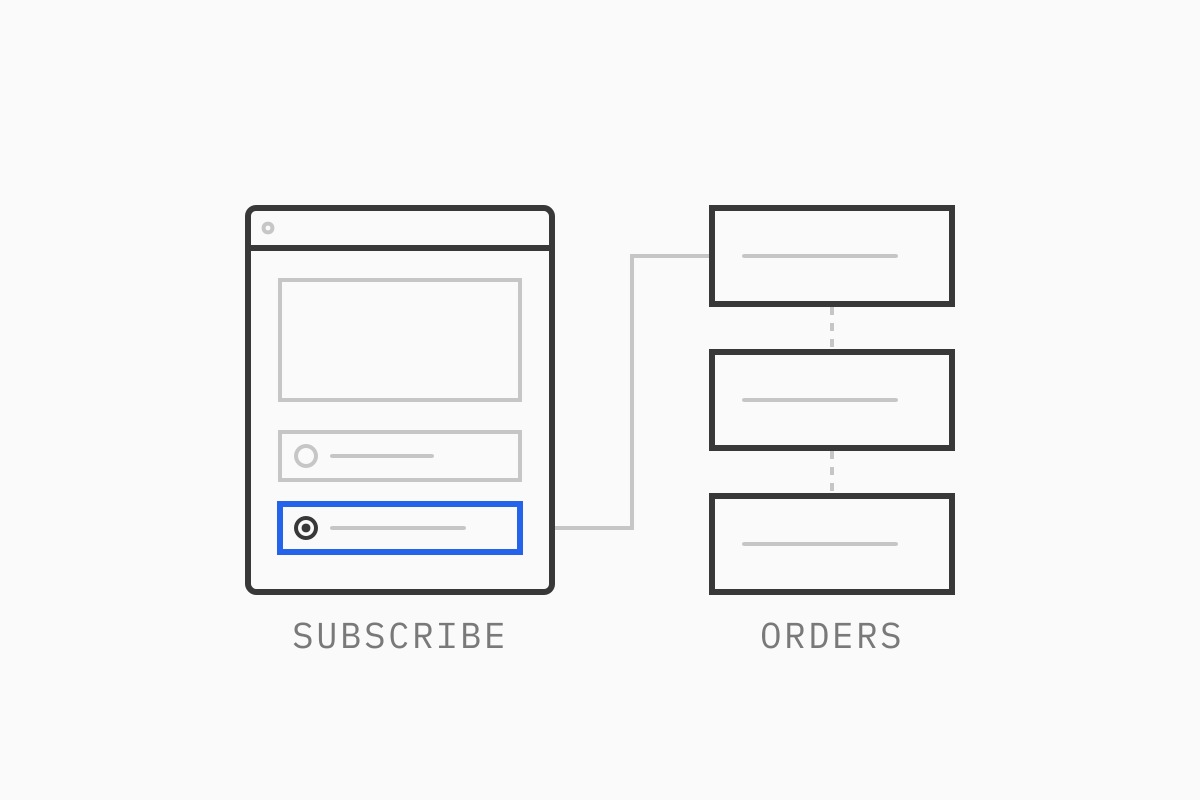
Today every subscription app on the Shopify App Store is built on the same foundation:
Subscription options on the product page set the offer, such as delivery every 30 days at 15% off.
Shopify’s checkout takes the first order and stores the customer’s payment details in Shopify.
A subscription record in Shopify keeps track of what each customer receives, how often and at what price. The app reads it to create each renewal order.
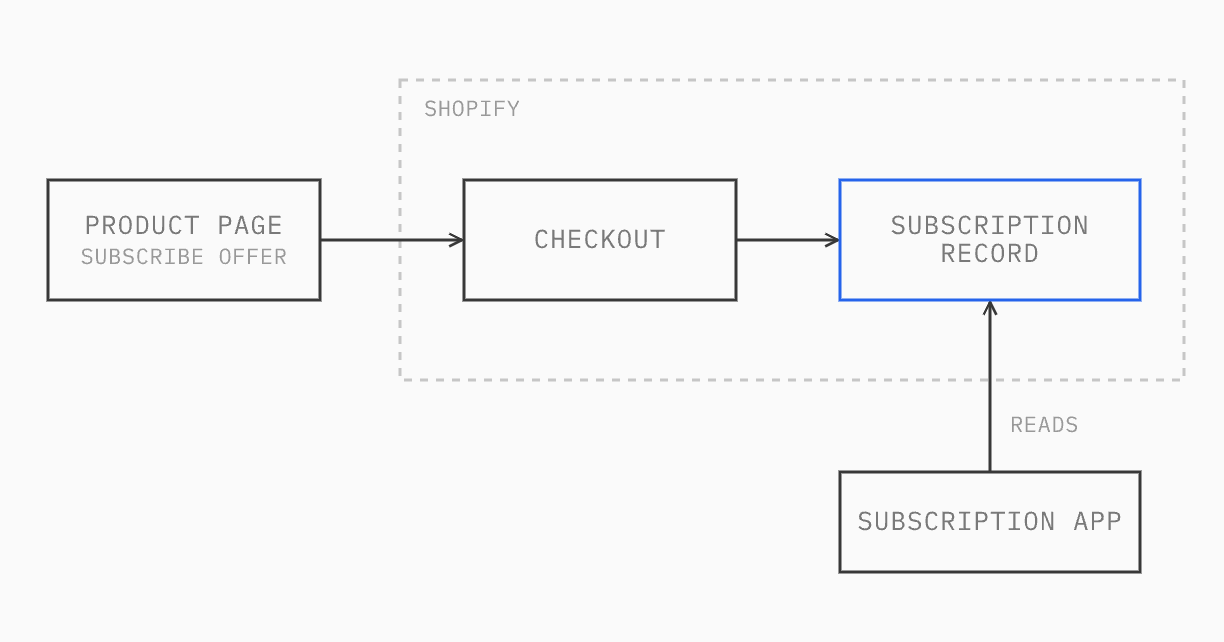
According to Shopify’s Help Center, those subscription records and payment details stay in Shopify if you uninstall a third-party app. The app’s other data is deleted after 48 hours. In practice, the app is the tool you use to manage subscribers, while Shopify holds the data that matters most.
This also works for headless builds, where a custom front end can offer subscribe-and-save options through Shopify’s checkout. If you’re considering a custom front end, read our comparison of headless and Shopify themes first; for most subscription brands, a Shopify theme is enough.
Two platform limits catch brands out:
Payment providers. Shopify lists Shopify Payments, PayPal Express, Authorize.Net and Adyen as supporting subscriptions, with Stripe available to select merchants only (source). Local and manual payment methods generally can’t be charged again for renewals.
Discounts and gift cards. Automatic discounts created in Shopify apply to every subscription order. Discount codes can be limited to a set number of subscription payments, so check that setting before you launch an offer. Gift cards only cover the first payment. Shopify Scripts, which Plus stores used for custom discount logic, stopped running on June 30, 2026. If your offer relies on custom discount rules built with Shopify Functions or a discount app, check that they apply to renewals, not just the first order.
02What to judge a subscription app on
1. Can you switch apps later without losing subscribers?
Most comparisons skip this question, and it’s the one that costs the most when it goes wrong. Ask each vendor:
Where are subscriptions and payment details stored? The answer should be “in Shopify”. Anything kept only in the app (custom bundle rules, loyalty points, notes, retention history) is what you’ll need to export if you ever leave.
Can you export all of it, including past orders and changes, not just a list of active subscribers?
Is there a minimum contract period? Read the order form, not the pricing page.
Payment details are the hard part. If cards are already stored in Shopify, moving between apps doesn’t require customers to re-enter them. If they’re stored with an outside provider such as Stripe, Braintree or Authorize.Net, Shopify can import them. PayPal accounts stored in Braintree are the exception: Shopify’s migration guide says they can’t be moved directly, so plan how you’ll contact those subscribers.
2. A customer portal that fits your brand
Subscribers use the portal to manage their subscription: skipping a delivery, swapping a product, changing frequency or adding a one-off item. It should feel like your store, not a plug-in. The questions we ask:
Can you fully restyle the portal, or only change its colors?
Can your developers build subscription features into your own pages, such as an upsell in the cart?
Does it work with Shopify’s customer accounts, including login without a password?
How does the cancellation flow work, and can you test different versions of it?
If you’re on a headless build, or you want subscription features inside your own pages, check which plan includes developer access. Recharge’s pricing page, for example, doesn’t include it on the Starter plan.
3. Built to work with Shopify
Every app on the Shopify App Store now uses Shopify’s subscription features, but they differ in how closely they work with Shopify’s checkout, customer accounts and Flow. The closer the fit, the fewer workarounds you need with Shop Pay and the rest of your apps, and the more of your data stays in Shopify, under your control. The Built for Shopify badge is a useful signal, but don’t rule an app out without it: at the time of writing, Loop and Appstle carry it, while Recharge and Skio don’t.
4. Cost as you grow
Most premium apps charge a monthly fee plus a percentage and a small fixed fee on every subscription order. With 2,000 subscribers, the monthly fee is most of what you pay; with 50,000, the percentage is. Compare the apps at the volume you expect, and ask for volume pricing once renewals reach seven figures a year. A difference of 0.25% on $5M of yearly renewals is $12,500 a year.
03Shopify subscription apps compared
Prices below are list prices at the time of writing (October 2026), from each vendor’s pricing page or Shopify App Store listing. Enterprise and volume deals are negotiated separately.
App | Best fit | Pricing | Switching help |
|---|---|---|---|
Recharge | The most integrations and the longest track record | Starter $99/mo + 1.49% + 19¢; Plus $499/mo + 1.34% + 19¢ | Full support on Plus |
Skio | Shopify Plus brands that want a fast portal and retention tools | $499/mo billed yearly ($599 monthly) + 1% + 20¢ per order | Included in onboarding |
Stay.ai | Retention, testing and bundles, with an account manager | Pro $499/mo + 1% + 19¢ | No setup fee; about two weeks |
Loop | Bundles and cancellation flows at a lower price | Free up to 50 subscriptions; Starter $99/mo + 1%; Pro $399/mo + 0.75% | Yes |
Appstle | Smaller or price-sensitive programs | Free tier, then $10–$100/mo by revenue; no transaction fee | Yes |
Shopify Subscriptions | Simple subscribe-and-save | Free | Imports existing subscriptions |
One thing to know: Recharge acquired Skio in April 2026. Both companies say the products will run separately for now, with a shared roadmap to follow. If you’re choosing between them, ask each about their plans for the next 12 to 24 months and get any commitments written into your contract.
Skio vs Recharge
This is the comparison we’re asked about most. Recharge has been on Shopify since 2014, has the widest range of integrations, starts at a lower price, and includes bundles and loyalty on its Plus plan. When we worked with it, our developers found the admin could feel slow on larger stores, and some customizations took more work than expected. Older stores may still use Recharge’s legacy checkout, and switching to Shopify’s checkout is a one-way change.
Skio came later and was built on Shopify’s subscription features from the start. Subscribers log in without a password, and the portal is designed to be quick to use. Its monthly fee is higher at entry, but its fee per order is lower than Recharge’s Starter and Plus plans. We’ve worked with both on the same store: Jupiter, a US haircare brand whose store we built, moved from Recharge to Skio in November 2022.
Recharge alternatives
If you’re moving off Recharge at Shopify Plus scale, the usual alternatives are Skio, Stay.ai and Loop, and the table above compares their pricing. Since Recharge now owns Skio, brands that want a vendor outside that group can look at Stay.ai or Loop. For a smaller program, with a few hundred subscribers and one or two subscription products, Shopify Subscriptions or Appstle will cover you at little or no monthly cost. Move up when you need bundles, a custom portal or retention offers; our A/B testing guide explains how to check whether a cancellation flow or offer works.
04Moving to a new subscription app
Switching apps is mostly about moving data carefully, with customers who notice straight away if something breaks. The steps we follow:
List what you have. Every active, paused and failed subscription, every subscription offer, discount and bundle, and every tool connected to the old app (Klaviyo emails, Gorgias replies, analytics).
Decide how each one moves. Match old offers to new ones, and agree what happens to special cases: subscribers on an old price, prepaid subscriptions, subscriptions whose last payment failed.
Move payment details. Import cards stored outside Shopify, following Shopify’s guide to moving subscriptions.
Switch over in a quiet window. Choose a time with few renewals, pause changes in the customer portal, move the data, then check that subscriber numbers and next delivery dates match the old app.
Update the store. Product page options, the account link, order emails and any custom code that read data from the old app. On Jupiter’s switch, this was most of the work: the cart’s promotions relied on subscription data from Recharge, so we updated them to work with Skio.
Watch the first month of renewals. Compare renewal numbers and failed payments with the previous month before you uninstall the old app.
Switching apps before Black Friday
It can be done. Jupiter’s switch happened in mid-November 2022, a few weeks before Black Friday, and went smoothly because we planned around what affects revenue most, which for Jupiter was the cart promotions. If your switch falls close to a busy period, test these before you go live, and again before campaign traffic arrives:
Every cart promotion linked to subscriptions: subscriber discounts, free shipping thresholds and free gifts, including carts that mix subscription and one-time products.
A new subscription from product page to checkout, with the right offer, price and discount.
The first renewal for a subscriber you moved: right price, right date, saved card charged.
The account actions subscribers use most during promotions, such as adding a one-off item or skipping a delivery.
The risk with a late switch is changing code your campaign depends on at the last minute. Freeze everything else, and only keep the date if those checks pass.
When no app fits
Some subscription businesses outgrow apps altogether: Graze, the snack subscription brand we worked with, ran its subscriptions on its own platform, built by its in-house team, rather than an app. On Shopify, the equivalent is a custom app built on Shopify’s subscription features, which only makes sense when no existing app can handle your offer.
05Choosing your app
Pick the app you’d be happy to leave as well as the one you’d be happy to launch with. Shortlist apps that keep subscriptions and payment details in Shopify, check that the portal and developer access on your plan support the experience your designers want, then compare costs at the number of subscribers you expect in two years. For most Shopify Plus brands in food, beauty and wellness, that leads to Skio, Recharge, Stay.ai or Loop, and the choice between them comes down to your bundles, your portal and your price at volume.
We’ve been a Shopify Select Partner since 2019 and have launched more than 25 Shopify stores. If you’re choosing an app or planning a switch, see how our Shopify development team works, or book a call and we’ll look at your current setup with you.
06FAQ
What is the best subscription app for Shopify?
For Shopify Plus DTC brands, Skio, Recharge, Stay.ai and Loop are the strongest options; the right one depends on your portal, your bundles and the cost at your volume. For a small subscribe-and-save program, Shopify’s free Shopify Subscriptions app or Appstle is often enough.
Skio vs Recharge: which should I choose?
Recharge has the longer history, more integrations and a lower entry price. Skio was built on Shopify’s subscription features from the start and charges less per order but more per month. Recharge acquired Skio in April 2026; both still run separately, so ask each about their roadmap before you sign.
What happened to Yotpo Subscriptions?
Yotpo discontinued its subscriptions product on May 31, 2025. Brands that used it had to move to another app, such as Recharge, Skio, Stay.ai or Loop.